
This Cardano price analysis was published on and is not the latest edition.
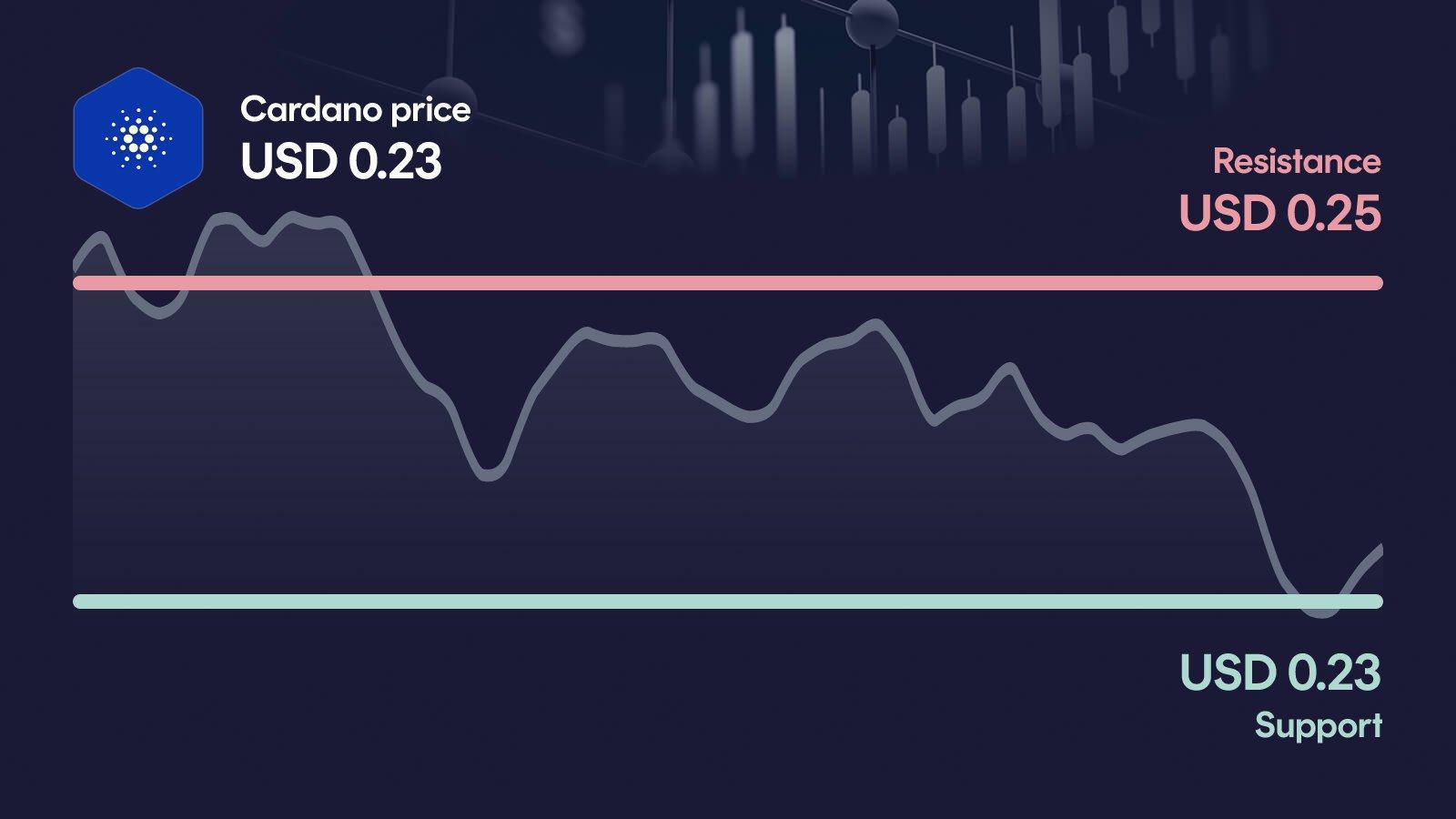
Cardano is under pressure and pressing against the support zone near $0.231. The MACD remains bearish, RSI is sliding toward oversold territory and volume is below the 30-day average. If this support breaks, the next downside reference comes into focus quickly.
Key takeaways in a nutshell
Pressure stays on: ADA trades at $0.2349, down 6.65% over the past 7 days.
Trend clearly weak: Price sits 7.2% below the 50-day and 27% below the 200-day moving average.
Support must hold: The $0.231 zone is the line in the sand: below it, $0.225 comes into play.
Momentum fading: RSI at 36 is approaching oversold, while MACD remains firmly bearish.
Wide AI range: Year-end 2026 forecast spans $0.247 to $0.449, with a midpoint near $0.333.
What happened to the Cardano price?
Cardano is trading at $0.2349, down 6.65% over the past week and 5.49% over the last 30 days. The weekly high at $0.254 was rejected cleanly, and price has since drifted back toward the lower edge of its recent range near $0.228.
The most notable signal is volume: 24-hour turnover sits at $318 million, around 15% below the 30-day average. That tells a clear story: there is selling pressure, but no aggressive capitulation, and buyers are not stepping in with conviction either.
Key price levels for Cardano
These are the key zones now: The resistance at $0.249 is the next major hurdle, and a move above it would put the $0.260 area back in play. On the downside, $0.231 acts as primary support, sitting just below the current price and aligning with the recent weekly low zone. If Cardano loses this level, the next relevant reference is $0.225, the secondary support from the monthly low region.
Cardano indicators: RSI, MACD and volume
The three indicators currently paint a fairly consistent, cautious picture. The RSI at 36 is not yet oversold, but it is clearly leaning into weakness and signals that momentum has shifted to the downside. The MACD is bearish at -0.0048 and the histogram series has stayed in negative territory for days, confirming that sellers have controlled the short-term trend. Volume sits 15% below the 30-day average, which means the move down is happening on tepid participation rather than a panic flush. Taken together, the setup looks like controlled weakness: the trend is not broken to the upside, but downside pressure has not yet reached a true exhaustion point either.
Relative Strength Index
MACD
Cardano indicators: RSI, MACD and volume
The three indicators currently paint a fairly consistent, cautious picture. The RSI at 36 is not yet oversold, but it is clearly leaning into weakness and signals that momentum has shifted to the downside. The MACD is bearish at -0.0048, and the histogram series has stayed in negative territory for days, confirming that sellers have controlled the short-term trend. Volume sits 15% below the 30-day average, meaning the slide is happening on tepid participation rather than a true capitulation flush. Together, the picture is one of controlled weakness: no panic selling, but also no visible buying interest stepping in.
Relative Strength Index
MACD
AI forecast for Cardano
Looking toward year-end 2026, our AI forecast model places Cardano in a range between $0.247 and $0.449. The central expected value sits at around $0.333, but this number should not be read as a price target: it is the midpoint of a broad probability distribution, not a forecast in the classic sense.
The width of the range matters more than the midpoint. In the conservative case, ADA would gain about 5% from current levels, while the optimistic case implies upside of roughly 91%. That spread reflects exactly the current situation: the trend is weak, but the long-term setup is not yet decided, and the next move from the $0.231 support area will play a significant role in which part of the range becomes realistic.
What could happen now?
Bullish scenario
For a constructive turn, Cardano would need to reclaim the $0.249 resistance on noticeably higher volume than we are seeing today. Then the short-term setup would improve clearly, the recent lower-high pattern would be challenged, and the path toward the $0.260 area would open up. The RSI has room to rise from 36 without overheating, and the MACD histogram would need to start curling upward to confirm the shift. Most importantly, the $0.231 support should not be lost again, otherwise the breakout attempt loses its foundation.
Trigger: > $0.249 with elevated volume
Bearish scenario
If $0.231 breaks on a daily close, the current weakness would gain another leg. The next relevant reference is $0.225, the secondary support from the monthly low area, and below that the picture turns increasingly fragile. A sustained move under this zone would also keep ADA firmly below both the 50-day and 200-day moving averages, putting additional pressure on the medium-term trend. In that case, the market would need to show whether real demand returns at lower levels or whether sellers simply keep the upper hand.
Trigger: < $0.231
Conclusion: $0.231 decides the direction
The technical setup is fragile, but not yet broken: price is hugging support, momentum is weak and volume is muted, which leaves the situation genuinely undecided. The decisive area is the narrow band between $0.231 support and $0.249 resistance.
A reclaim of $0.249 on stronger volume would shift the short-term tone and put $0.260 back into focus. A clean break below $0.231, on the other hand, would expose $0.225 and keep ADA pressed against a clearly bearish higher-timeframe trend. The next few trading days are likely to set the direction.
Want to buy Cardano? Kraken is our recommended crypto trading platform.
Continue to KrakenSince 2017, Philipp Duringer has been deeply involved in Bitcoin, crypto assets and digital financial markets. As the founder of Coinbird, he combines years of crypto experience with more than 15 years of technical experience in IT and digital products. His goal is to make crypto easier to understand, more transparent and easier to compare.
About the authorAI-assisted: This price analysis is generated automatically based on structured market data and reviewed through defined quality rules. It is for informational purposes only and is not financial or investment advice or a recommendation to buy or sell crypto assets.